
In the Initial Consultation, I listen… traditional acupuncturists spend time understanding their patients and their symptoms. This helps us know which of the 350 points on the body will be best for that particular person, on that particular day.
Fine, sterilised needles are used on different acupuncture points on the body, to improve the body’s energy flow. I also use moxa (see “What herb do you burn?” below) where appropriate.
Follow up treatments last for an hour. Just as no two patients are the same, each treatment is different: reflecting exactly what each person needs at that moment.
Some people avoid acupuncture, as they are needle phobic… but they don’t need to. Acupuncture needles are very fine – about the thickness of two human hairs. In Five Element Acupuncture, most needles are only inserted for 1-2 seconds.
Many people describe being needled as a dull ache or slight pulling sensation at the point, which only lasts for a couple of seconds. Sometimes patients can identify – and point to – a sensation along the exact channel, even though they don’t know it exists. With other types of acupuncture, a practitioner will leave the needles in the body for about 20 minutes, and may leave the room. With Five-Element treatments, the needles don’t stay in longer than a few seconds and I stay by your side through the whole session.
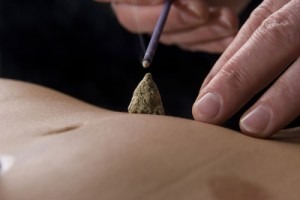 Moxa is a traditional Chinese medicine technique. It involves burning mugwort (Artemia Vulgaris), a herb, to promote healing. During moxibustion, an essential part of Chinese medicine, the moxa is placed either directly on the skin, or a moxa stick is held just above specific acupuncture points. As it smoulders slowly, a therapeutic warmth penetrates the skin and improves the flow of qi and blood in the area being treated. It helps warm and relax tense muscles, and can even be used on certain points to help breech babies turn (if it is safe for them to do so)
Moxibustion is a specialist technique demanding skilled clinical judgement and is contraindicated in certain cases.
Everyone responds differently: chronic conditions can take longer to heal than recent ones. A patient’s age and overall health can also affect the pace of improvement. Treatment plans are individual – to provide what will work best for you. I generally recommend a course of 6 treatments, initially weekly, then more spaced out as your symptoms improve.
Many people decide to continue to have treatment, to maintain health once their initial symptoms improve, this can be monthly or only a few times a year.
Yes, when administered by a fully trained and qualified professional. Jeanie has a Lic.Ac and is a member of the British Acupuncture Council. Membership is only granted to acupuncturists who have degree-level training.
“Our members belong to an accredited register, regulated and approved by the Professional Standards Authority for Health & Social Care (PSA). The PSA protects the public by overseeing the regulation and registration of healthcare professionals – including statutorily regulated professions, such as the Nursing and Midwifery Council, and Accredited Registers like the BAcC. This offers a quality mark for high standards of training, safe practice and professional conduct.” British Acupuncture Council
Side effects are very rare. All needles are sterile and used only once. Strict hygiene practices are followed in accordance with BAcC guidelines.
There are certain points and procedures that are contraindicated (in pregnancy, or for people with certain health conditions such as high blood pressure) – this keeps treatment safe for all.
A physiotherapist (or osteopath or chiropractor) uses “dry needling”. Needles are inserted in trigger points to ease muscle pain or tightness. This can be beneficial for immediate pain relief.
A traditional acupuncturist (eg Jeanie) looks to resolve the root cause of the problem, and works at a physical, mental and emotional level: as well as pain relief, a treatment will aim to improve the patient’s mental and emotional well-being. Using this approach gives a holistic treatment. Many patients report that other underlying niggling problems are also resolved by treatment, as well as the symptoms that brought them to acupuncture.